Which Expiry's Gamma Regime Are You Reading?
At Deribit's daily expiry roll, 90.9% of the changes in BTC's headline gamma regime are the pointer moving to a new contract, not the option book repositioning.
On 10 September 2026, at 05:10 UTC, the gamma regime flipped on all six coins Cayø Largo tracks. Bitcoin, Ethereum, Solana, Ripple, Avalanche, Tron. One ten-minute cycle, six regime changes, every one of them in the same direction of surprise. That is the kind of line a desk screenshots.
Nothing happened. Deribit's calendar rolled. The "next expiry" slot stopped pointing at Thursday's daily contract and started pointing at Friday's weekly and every label hanging off that slot moved with it. The market did not reposition. The pointer did.
In this note we take that apart. First we separate the two things a gamma regime can mean, namely the slot and the contract, then we measure how far apart they sit across 224 daily rolls on Bitcoin. Then we freeze one cycle and ask what the listed expiries say about each other at a single instant. Then we time how long the label survives at all. The deliverable is one habit you can adopt this afternoon and it costs nothing.
Here is the headline. Across 224 daily expiry rolls on Deribit between 1 March and 9 September 2026, the gamma regime printed against Bitcoin's nearest expiry changed on 68.8% of them. Follow the same contract across the roll rather than the slot it happens to occupy and the label changed on 9.4%. So 90.9% of those headline flips are the pointer moving to a new contract, not the option book repositioning.
1. The slot is not the market
Every gamma-exposure dashboard has to choose an expiry. Most choose the nearest one. Then they present what they find as a property of the underlying and the choice disappears from the output. It moves every day and nobody sees it move.
There is an astronomy version of this mistake and we made it once. Measure the brightness of "the third star from the left" on successive nights and you will find a wonderfully variable object. The field has drifted. You were never measuring one star. Photometry only means something when you lock onto the same source first, night after night. Options are no different.
Deribit lists a new daily contract each morning. The contract that occupied the slot has expired. The contract that occupies it now was sitting one rung further out ten minutes ago, with its own strikes, its own open interest and its own zero-gamma level. Nothing about the market has to change for the label above the chart to change.
The fix is to stop tracking the slot and start tracking the contract. Cayø Largo stores every listed expiry separately at ten-minute cadence, what lets us follow one instrument across the roll and set it against what the slot said at the same moment. The gap between those two readings is the size of the artefact. Let's measure it.
Write it down and the confusion disappears. The slot is a selector, re-evaluated every cycle.
where is the set of expiries the pinning layer tracks at cycle , is the contract's hours to expiry and is whichever contract happens to be nearest at that moment. Nothing in that expression is a property of the market. It is a property of the calendar.
The two readings that follow are then different questions asked of the same field , the gamma regime label.
where is the set of roll cycles and returns one when the labels differ. The two expressions differ in one place, the subscript on the contract in the second term. The first compares two different instruments and calls the difference a regime change. The second compares one instrument with itself.
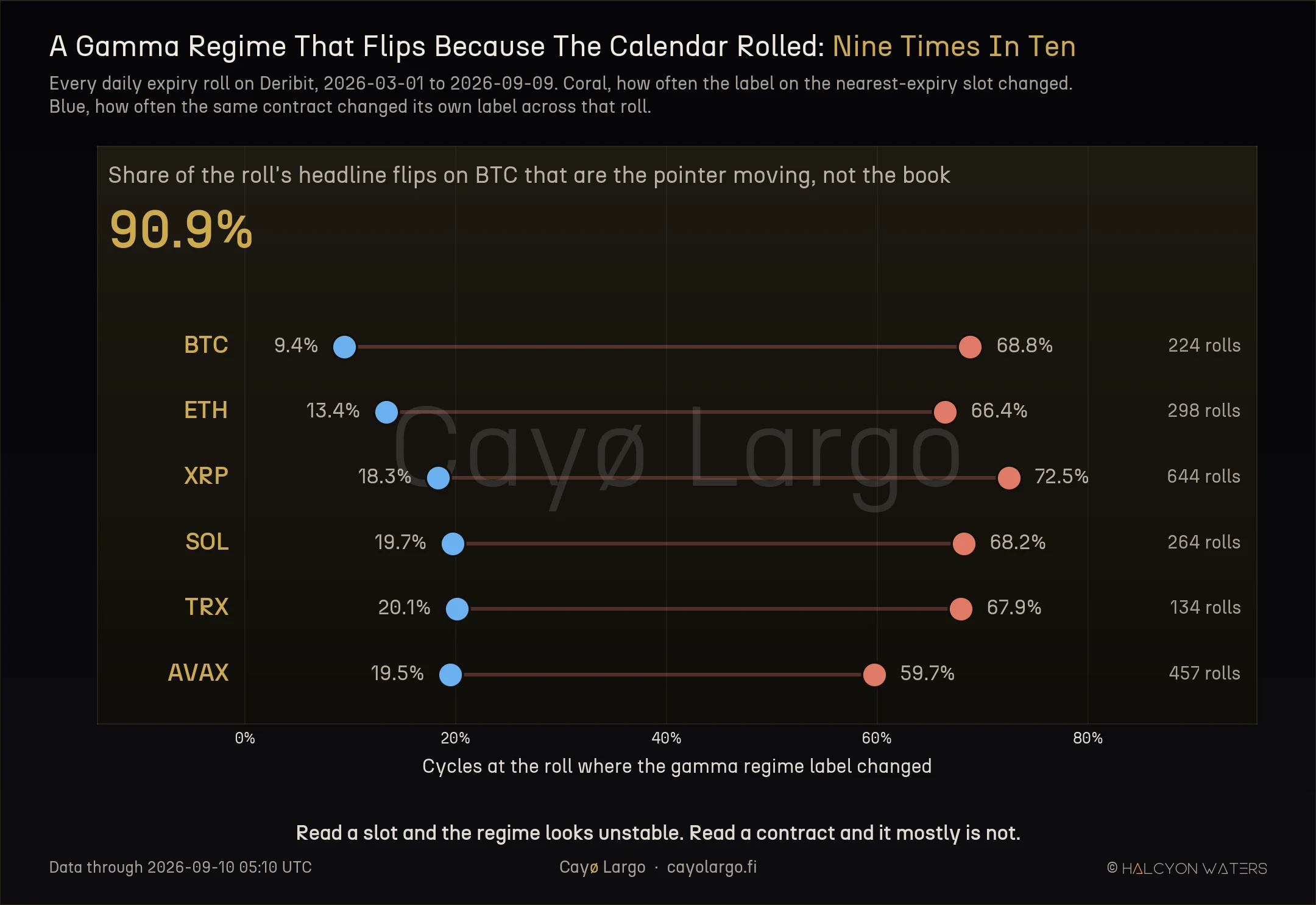
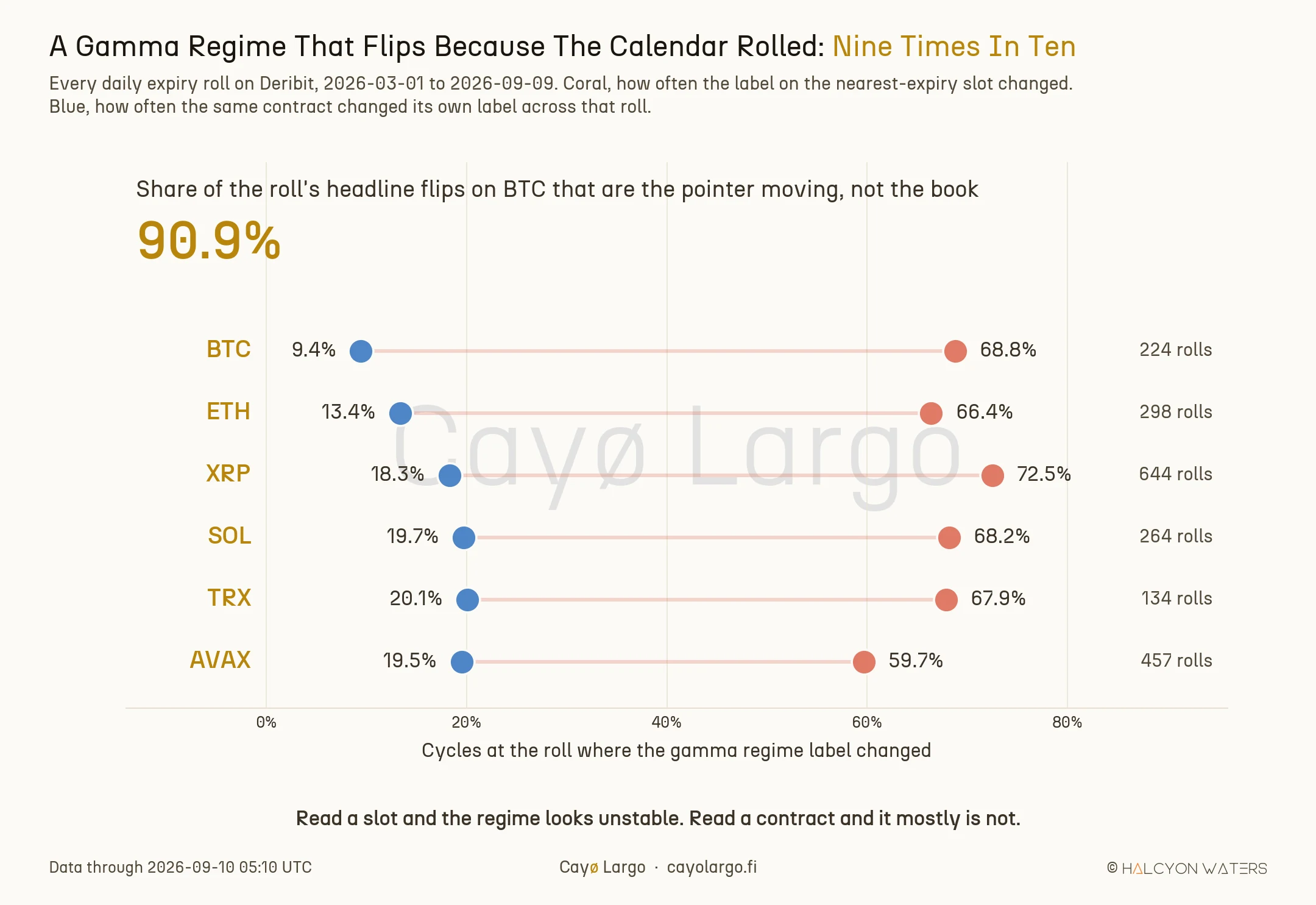
Figure 1: Each row is one coin. The coral marker is how often the gamma regime label on the nearest-expiry slot changed at a daily roll. The blue marker is how often the same contract changed its own label across that same roll. The distance between them is the calendar, not the market.
Have a look at the table before reading on. The pattern holds on all six coins and it does not behave the way you would expect.
| Coin | Forward rolls | Slot label changed | Same contract changed | Share that is the pointer |
|---|---|---|---|---|
| BTC | 224 | 68.8% | 9.4% | 90.9% |
| ETH | 298 | 66.4% | 13.4% | 81.8% |
| XRP | 644 | 72.5% | 18.3% | 80.5% |
| SOL | 264 | 68.2% | 19.7% | 78.3% |
| TRX | 134 | 67.9% | 20.1% | 78.0% |
| AVAX | 457 | 59.7% | 19.5% | 76.6% |
The instinct says the thin books should be the mess. They are not. Bitcoin, the deepest options book in crypto, carries the widest gap of the six: 68.8% against 9.4%, i.e. nine out of every ten flips at the roll belong to the calendar. Avalanche, with a fraction of the open interest, is the most honest coin on the list at 76.6%. Depth does not protect you here, because the defect is not about liquidity. It is about arithmetic.
2. One second, two verdicts
The roll is the dramatic version. The quiet version runs all day and it runs because the listed expiries do not agree with each other.
Take the nearest listed expiry against the second-nearest, cycle by cycle. Bitcoin's two readings disagree about the gamma regime on 46.2% of 27,536 cycles and they give outright opposite signs, positive against negative, on 3.4%. On the plain binary question of whether spot sits above the zero-gamma level, they disagree on 28.8%. Ethereum runs at 51.9%, 11.7% and 34.8%. The smaller books are worse, namely Solana at 63.5%, Ripple at 69.5% and Tron at 72.0%.
Nothing about 10 September was special. That is rather the point.
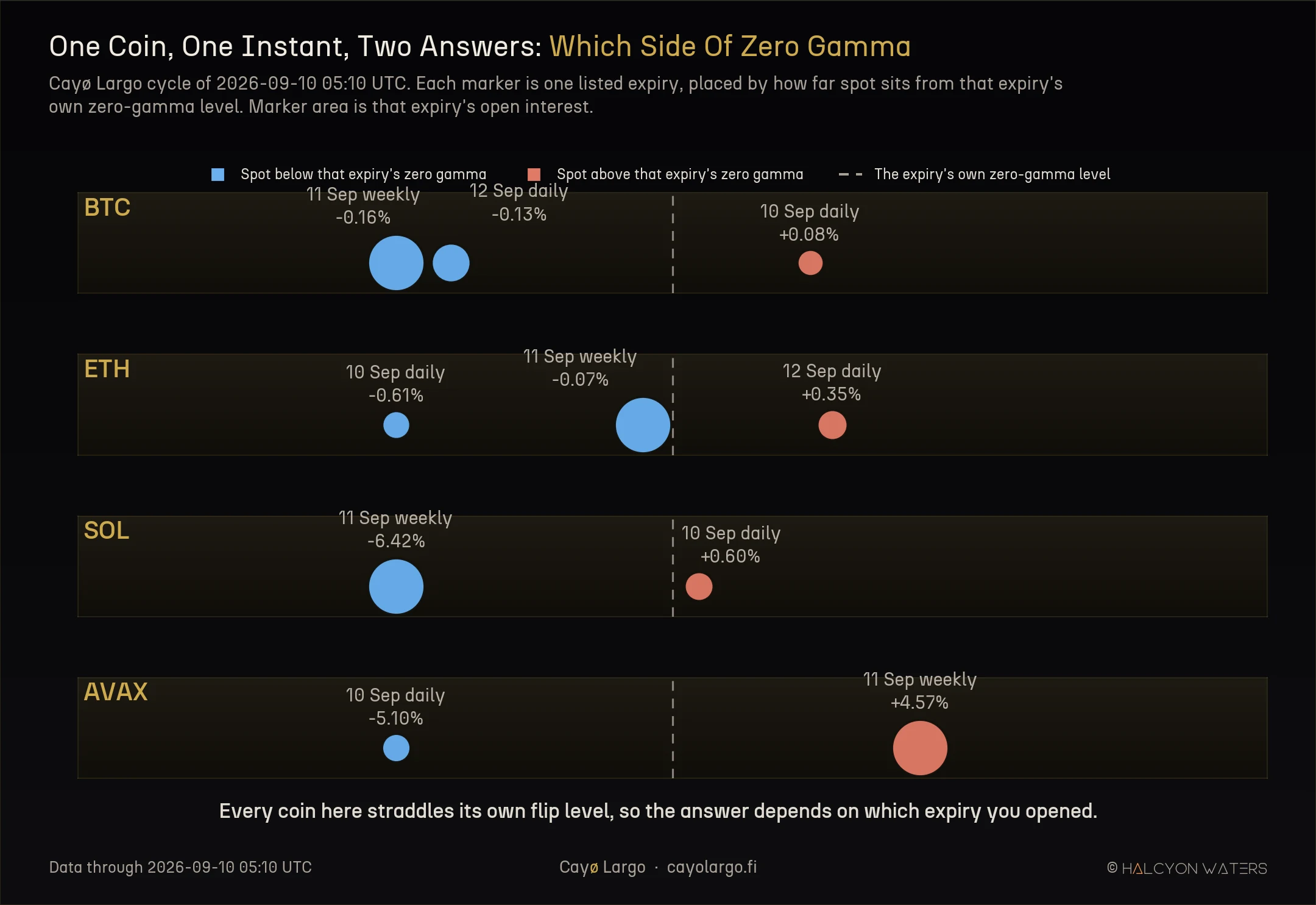
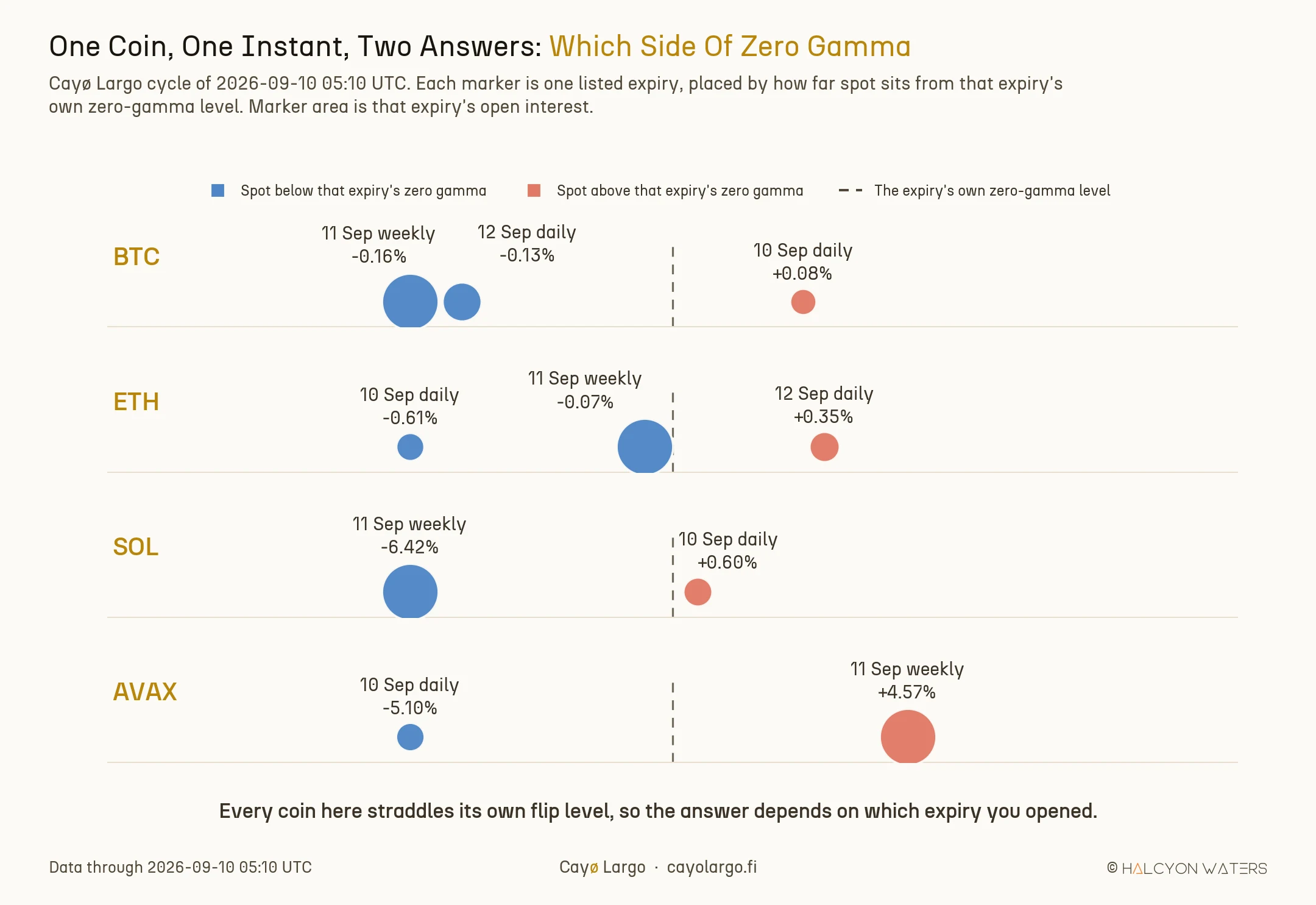
Figure 2: One cycle, 10 September 2026 at 05:10 UTC. Each bubble is one listed expiry, placed by how far spot sits from that expiry's own zero-gamma level and sized by that expiry's open interest. Coral is above, blue is below and the dashed line is the flip. Every coin here has expiries on both sides of it.
Read Bitcoin first. The 10 September daily, 2.8 hours left to run, $49.3m of open interest, put spot 0.08% above its zero-gamma level. The 11 September weekly, 26.8 hours left, $1,767m of open interest, put spot 0.16% below. Same coin, same second, opposite answers. And the contract that disagrees with the front is the one carrying 36 times the open interest. If you were quoting the front, you were quoting the smaller half of the book.
Solana was starker. Its front daily read positive gamma with the flip at 101.34, while the Friday weekly read negative gamma with the flip at 108.95. Two levels 7.5% apart, on one coin, at one instant, with spot sitting at 101.95 between them. Pick the wrong one and your hedging logic runs backwards. Avalanche did the same thing in the other direction: the front daily put spot 5.10% below its flip, the weekly 4.57% above and the weekly held thirteen times the open interest. Ethereum offered three expiries and three different answers. Tron and Ripple carried only one listed expiry at that cycle, so they cannot disagree with themselves and are not shown.
Six hours later, on the live page
None of the above needs a special reading of the data. The GEX Landscape draws it, one expiry at a time. It drew it again the same morning.
By 11:00 UTC the 10 September daily had settled and the slot had rolled, exactly as section 1 describes. Below is that cycle with two of the listed expiries on one pair of axes, which the page itself cannot show you, since it draws a single expiry per view.
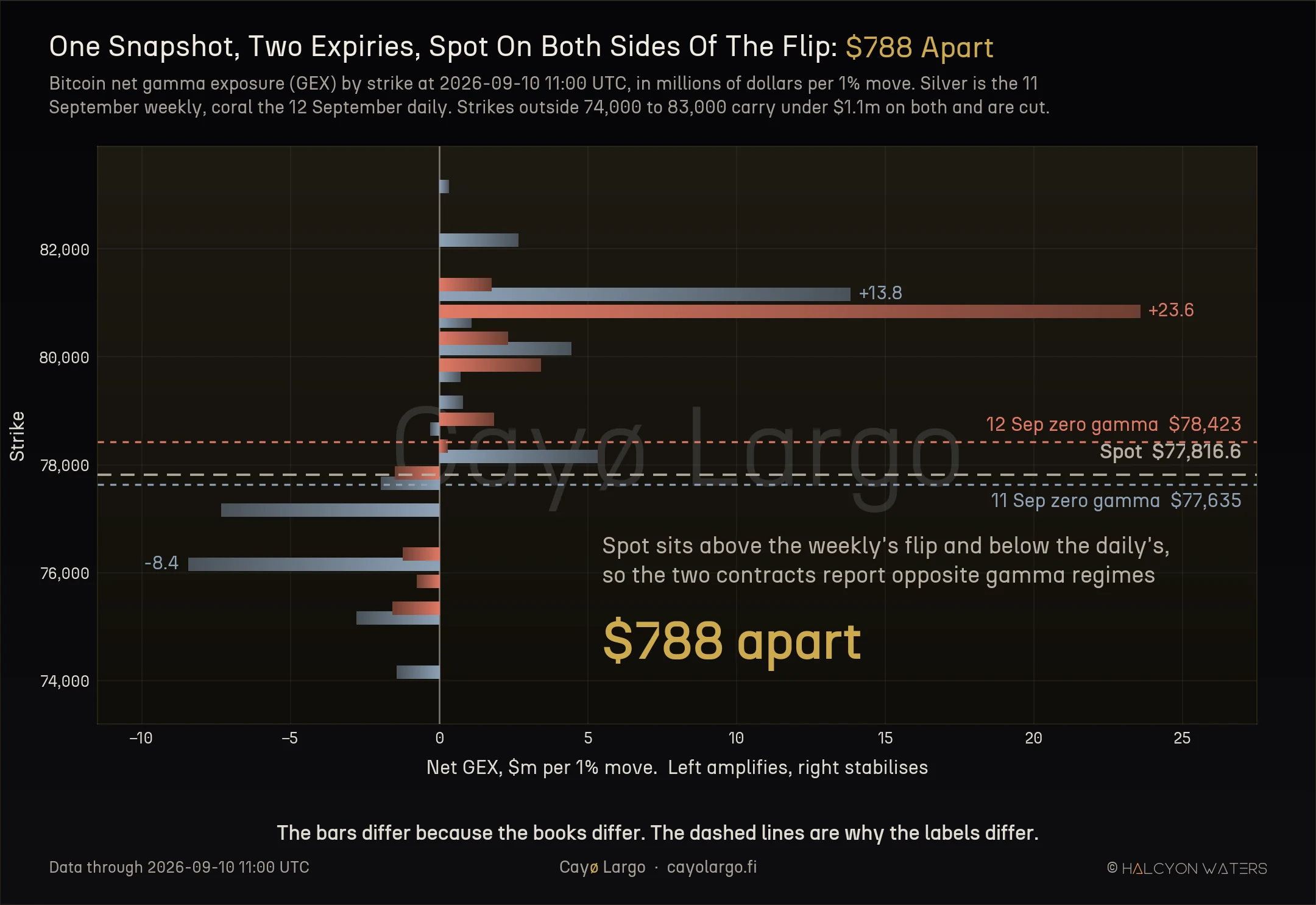
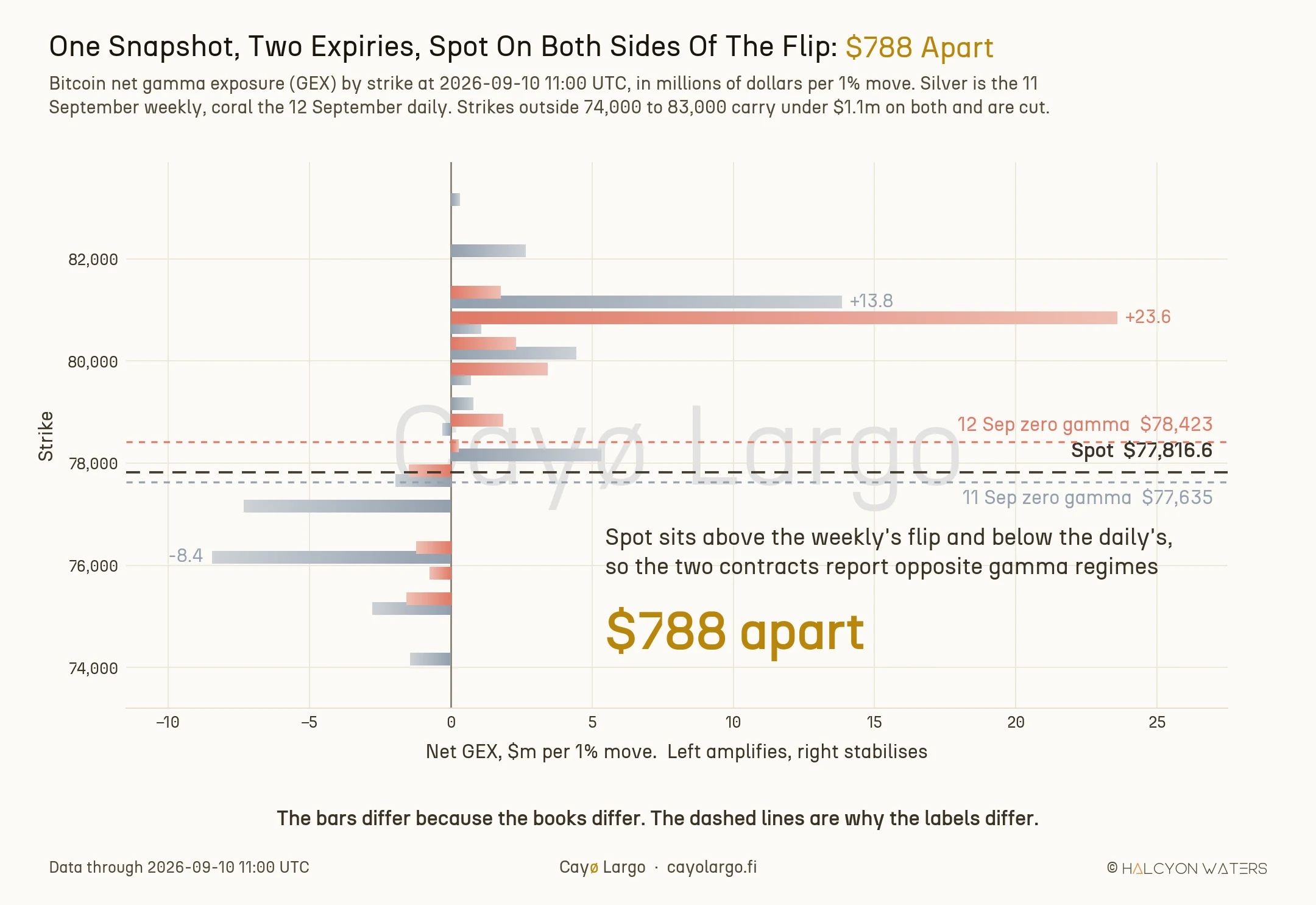
Figure 3: Net gamma exposure by strike, 2026-09-10 11:00 UTC, in millions of dollars per 1% move. Silver is the 11 September weekly, coral the 12 September daily. Read the three dashed lines rather than the bars: spot sits between the two expiries' own zero-gamma levels, so one contract has it above the flip and the other below.
The bars are two different books and both are drawn honestly. The dashed lines are the finding. On the 11 September weekly the flip is $77,635.33 and spot is above it, so the page reports the regime as NEAR FLIP, +0.23%. On the 12 September daily the flip is $78,423.25 and the same spot is below it, so the page reports NEGATIVE GAMMA, -0.78%. The two levels sit $788 apart with spot in the gap and the headline card changes wholesale depending on which expiry the reader clicked.
The third listed expiry is worth a line. At the same cycle the 13 September daily put spot 0.41% above its own flip, back on the other side again. Above, below, above, in one instant, carrying $1,345.6m, $640.6m and $66.2m of open interest respectively.
The rest of the two views disagrees just as much and each disagreement is honest. Both name $81,000 as the magnetic strike but the weekly holds 26% of its gamma there against the daily's 60%. Max pain reads $78,000 on one and $79,000 on the other. The pin score is 32 out of 100 against 52. These are not competing estimates of one quantity. They are correct readings of two different books.
3. A regime with the half-life of a coffee break
If the nearest expiry described a durable condition, the label would persist. It does not.
Reduce the reading to the plain binary of whether spot sits above the zero-gamma level. Bitcoin's nearest-expiry answer survives a mean of 2.45 hours and 31.2% of its runs last a single 10-minute cycle. Ethereum survives 1.51 hours, with 41.7% of runs lasting one cycle. Keep in mind what that means in practice. Roughly one flip in three is a state that existed for ten minutes and then stopped existing. You cannot build a hedging decision on that and no wonder why: it was never one object to begin with.
Persistence does exist. The longest unbroken Bitcoin run in the window was 427 cycles, about three days. It is simply not the normal case.
One more figure is worth carrying and it is the one we would put in front of a risk manager. Bitcoin's nearest expiry holds 35.4% of the open interest across the expiries our gamma-pinning layer tracks. Its answer to the same binary question disagrees with the open-interest-weighted answer across those expiries on 17.6% of cycles. Ethereum is 20.7%, Solana 27.4%, Ripple 31.7%, Avalanche 40.0%. In other words, roughly one cycle in five or six, the front contract says the opposite of where the weight of the book actually sits.
4. Not only a crypto problem
The mechanism is arithmetic, what means it turns up wherever an expiry calendar does.
OptionMetrics measured the equity-index version in March 2026. They looked at the third Thursday of each month, when a weekly Thursday expiry and the standard monthly Friday contract are both alive at once. Over a sample running May 2022 to February 2026, the median zero-day S&P 500 skew at 15:45 reached 0.167 on those third Thursdays against 0.006 on other Thursdays. Their one-day table, same window, same timestamp, barely moved: 0.020 against 0.020. Same index, same minute, two expiry slices, an order of magnitude between them. Their own word for it is mechanical rather than informational. That is the whole argument of this note, written about a different asset class three thousand miles away.
Practitioners reading their own books already decompose this way. VolSignals, writing about S&P 500 market-maker gamma in August 2026, split the profile by expiry bucket and found that week's expiries carrying $6.8bn of long gamma per 1% while the positions from the previous 21 days carried $2.3bn short. One aggregate, opposite signs inside it. Vitor Gaspar's note on pin risk on expiry day makes the case that the final session is a regime of its own, where deltas turn binary and gamma piles into a single strike. That is precisely the contract most dashboards elect as the headline.
The convention is not hidden either. Amberdata's Q2 2023 review on Deribit Insights sets out the gamma-exposure methodology it inherits from the 2016 SqueezeMetrics paper, tallies dealer inventory per strike and presents the result explicitly for one named expiration cycle. The care is there, in the source. It goes missing somewhere between the source and the headline.
5. How we measured it
Read from deribit_options_gex_pinning, the table behind the GEX pinning endpoint, at 10-minute cadence across all six coins Cayø Largo covers, 1 March to 9 September 2026. The regime label is the gamma_regime field and the binary reading is price_above_zero_gamma. Expiries are ranked within each cycle by hours_to_expiry, so slot one is the nearest listed expiry and slot two the next. A roll is a cycle where slot one's expiration_timestamp moved forward. The contract-tracked comparison joins on expiration_timestamp across consecutive cycles, what asks a different question of the same data: how was this instrument labelled ten minutes ago, when it sat one rung further out? The live cycle in Figure 2 is 10 September 2026 at 05:10 UTC. The same per-expiry structure is drawn live on the GEX Landscape and the long-form walk through every chart on that page is in how to read gamma exposure on a live Bitcoin book.
6. What we do not know yet
None of this says the gamma regime is meaningless. The nearest expiry is the right thing to read when what you care about is today's pin, which is exactly the case Gaspar describes. It says the label belongs to a contract and it should be quoted with one.
Two limits, stated plainly. The nearest expiry occasionally moves backwards between cycles, meaning an expiry drops out of the pinning set and comes back. Bitcoin is cleanest, 33 backward transitions against 224 forward. Ripple is the worst at 564 against 689. We exclude backward transitions from both sides of the roll comparison rather than counting them as "no roll", so the thin books carry more uncertainty than Bitcoin and Ethereum do and we would not lead a client conversation with Ripple. Second, gamma_regime here is the pinning layer's own open-interest-based label. It is not the taker-flow-corrected gamma exposure we publish elsewhere and the two must not be conflated.
The bigger gap is the one we have not closed. We have shown that the contract-tracked reading is more stable. We have not shown that it is more useful. Stability is not edge and proving the second needs an outcome variable, a horizon and a proper backtest, none of which are in this note. That study is on our desk.
7. What to watch
Quote the expiry with the regime. Every time. "Spot is above zero gamma on the 11 September weekly, which holds 92% of the tracked open interest" is a claim a colleague can check and "BTC is in positive gamma" is not. On a Thursday, when the next-expiry slot rolls from a daily onto the Friday weekly, expect every label attached to that slot to move at once, on every coin. Read that as the calendar until a contract-level comparison tells you otherwise.
A measurement is only as good as the thing it is pointed at. Lock onto the source first, then read the light.
References
- Amberdata, Decoding Option Flows: Q2, 2023, Deribit Insights, 25 July 2023. Sets out the gamma-exposure methodology inherited from the 2016 SqueezeMetrics paper, tallies net dealer inventory per strike and presents the result for one named expiration cycle.
- Vitor Gaspar, Pin risk. What happens to an option book on expiry day, LinkedIn, 27 July 2026. Argues that expiry day is a regime of its own: deltas turn binary, gamma piles into a single strike and the greeks that carried the book for months stop being useful in the final hours.
- VolSignals, Locally, gamma should be MORE stabilizing here, X, 18 August 2026. Decomposes S&P 500 market-maker gamma by expiry bucket and reports opposite signs inside one aggregate: that week's expiries long $6.8bn per 1%, the previous 21 days' positions short $2.3bn.
- Oscar Shih, When Two SPX Expirations Collide: What Happens Every Third Thursday at 3:45 pm?, OptionMetrics, 11 March 2026. Measures a median zero-day skew of 0.167 at 15:45 on third Thursdays against 0.006 on other Thursdays, with the one-day slice flat at 0.020 in both and calls the effect mechanical rather than informational.
Frequently Asked Questions
Does the gamma regime depend on which expiry you look at?
Yes and far more than most dashboards suggest. Across 27,536 Bitcoin cycles from 1 March to 9 September 2026, the nearest listed expiry and the second-nearest disagreed about the gamma regime on 46.2% of cycles and gave outright opposite signs on 3.4%. On Ethereum the two figures are 51.9% and 11.7%.
Why does the gamma regime flip at the daily expiry roll?
Because the slot changes contract, not because the book changes position. At Bitcoin's daily roll, the label attached to the nearest-expiry slot changed on 68.8% of 224 rolls. Following the same contract across the roll instead of the slot, the label changed on 9.4%. So 90.9% of those headline flips are the pointer moving.
How much of the option book does the nearest expiry represent?
A minority of it. Bitcoin's nearest listed expiry holds 35.4% of the open interest across the expiries Cayø Largo's gamma-pinning layer tracks. It has a mean 16.6 hours left to live. Its answer to whether spot sits above zero gamma disagrees with the open-interest-weighted answer across those expiries on 17.6% of cycles.
How long does a gamma regime label actually last?
On Bitcoin's nearest expiry, the binary reading of whether spot sits above the zero-gamma level survives a mean of 2.45 hours and 31.2% of its runs last a single 10-minute cycle. On Ethereum the mean is 1.51 hours and 41.7% of runs last one cycle.
Related Articles
How to Read Gamma Exposure: Bitcoin GEX Live Case Study
BTC trades at $77,140 with $51 million in put open interest stacked at $76,000 and the gamma regime deep in negative territory. Expiry is 16 hours away. Here's how to read every chart on the GEX Landscape page and what each one tells you about what happens next.
How Noisy Is the 25-Delta Risk Reversal?
BTC's front-week 25-delta risk reversal moves 2.07 volatility points every ten minutes and travels only a third of the expected distance across a day.
Where the ETH Gamma Wall Cracks: Finding the Breakout Strike
You open the Dual Gamma heatmap for ETH and see a thick wall at $2,100. Impenetrable. Switch to Lightning and the wall shows where it cracks.