Deribit Outage: What Happens to the Options Order Book
When Deribit stops trading, does the options order book pause or disappear? We read the BTC book every ten minutes through three stoppages in November 2026. Each time it emptied. After a short halt it refilled within the hour, while after a 130-minute outage the first book back was thin and slow to fill.
At 16:09 UTC on Friday 20 November Deribit stopped matching trades. A trader holding the BTC 58,000 put expiring a week later had seen 333 contracts bid and 308 offered on it ten minutes earlier. At 16:20 the best bid was 0.0060 BTC for a tenth of a contract, against a mark price of 0.0212. The book had not paused. It had gone. What stood in its place was a handful of quotes nobody meant to trade on.
That was the first of two stoppages that day and the second of three that month. We read the BTC options book every ten minutes through all three. Two questions matter to a desk: does the book come back balanced and how long does it take? Readers who know how an order book is built can skip the next section.
What is order book depth and what does a halt do to it?
An exchange order book is a list of resting orders on each side: bids are the prices buyers will pay, asks the prices sellers will accept, each with a size in contracts. Depth is how many contracts rest across those price levels, not just at the best one. On Deribit most of that depth comes from market makers, who keep quotes on both sides and move them every few seconds with the underlying.
Figure 1 shows one option's book through the 20 November halt. At 16:00 it held 333 contracts bid and 308 offered. All of it sat within a few ticks of the mark price. At 16:10, a minute into the halt, most of it was already gone. At 16:20 the only quotes left sat far from the mark, a bid at 0.0060 and an ask at 0.0280, each for 0.1 contract. Six minutes after trading resumed, 259 contracts were bid again.
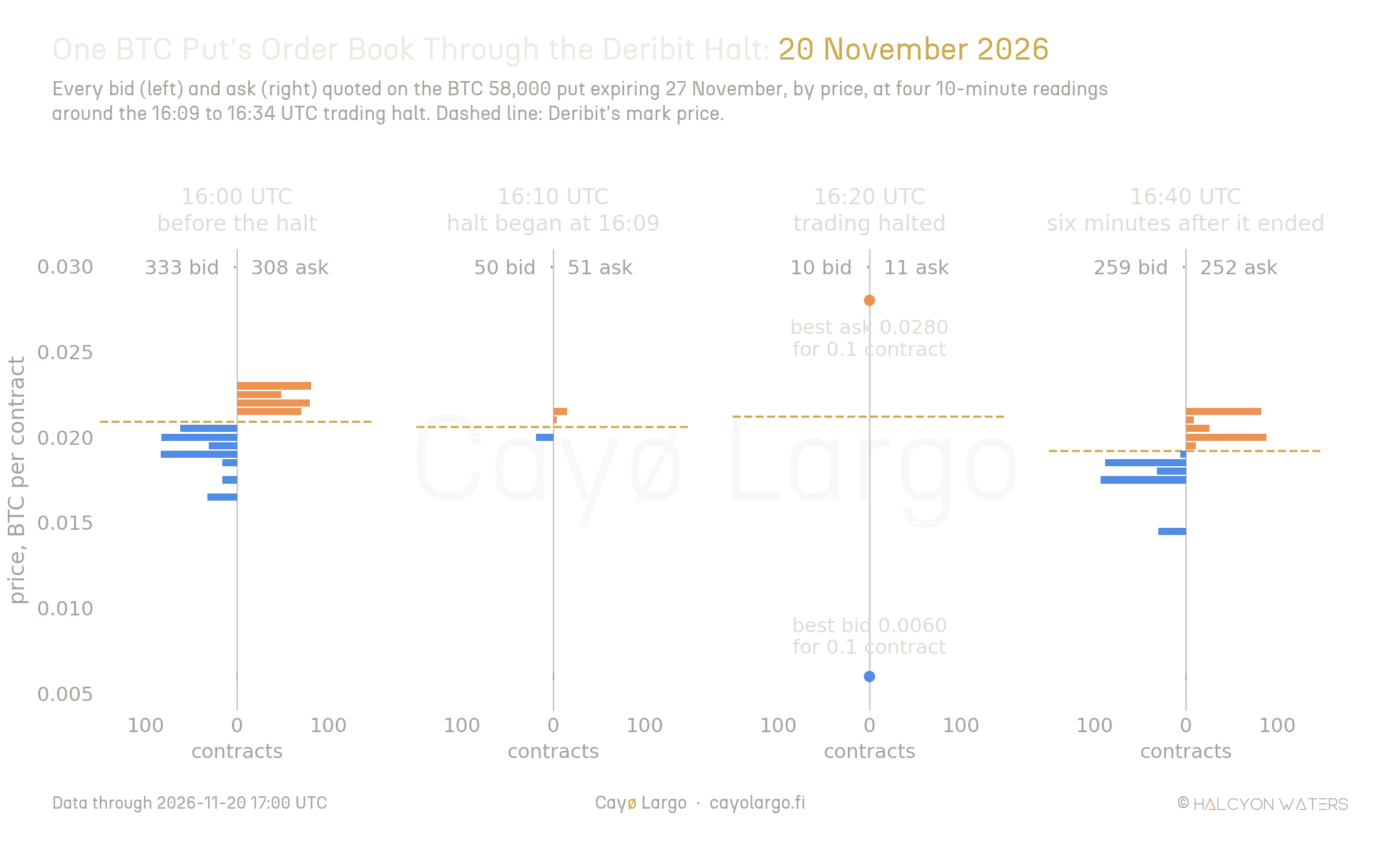
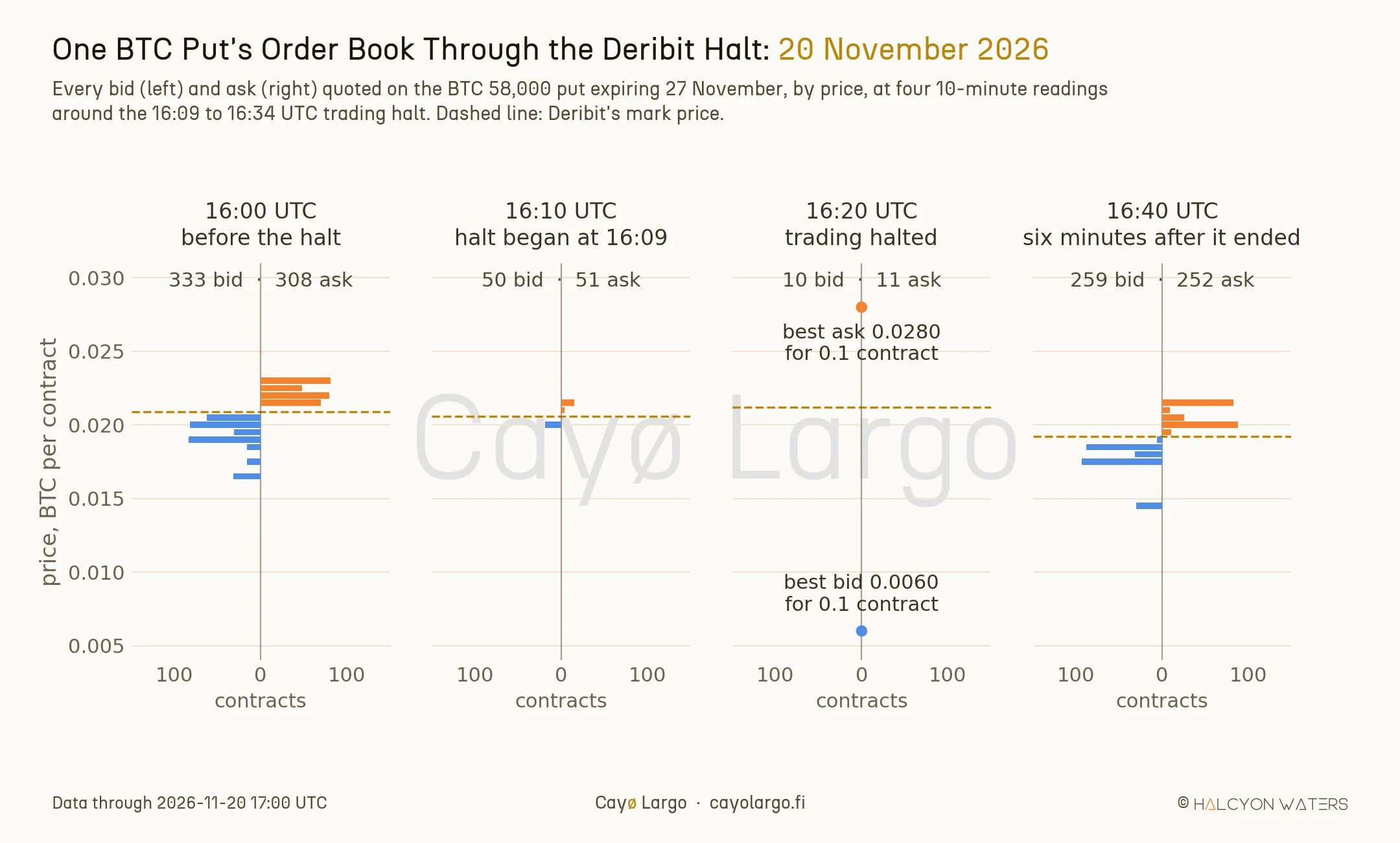
Figure 1: One BTC put through the 20 November halt. Blue bars are bids, orange bars are asks, the dashed line is Deribit's mark price. The totals at the top sum all contracts quoted on each side.
To measure this across the whole market we add up the book option by option, for every 10-minute reading:
where is book depth at reading in contracts and and are the contracts at bid level and ask level of option . The set holds the out-of-the-money BTC options expiring within 30 days, with a strike within 15% of the underlying and a usable two-sided book, i.e. a bid and an ask no more than 50% of the mid apart. These are the options you reach for first after a restart.
Three stoppages in one month.
Deribit stopped trading three times in November 2026. Each stoppage emptied the book. On 5 November trading halted from 15:25:58 to 15:38:35 UTC, after BTC had fallen 4.2% in the hour to 15:27. On 20 November it halted again, from 16:09 to 16:34. BTC was quiet near 59,300. At 19:20 the exchange went down altogether, until 21:30. All times are matched against Deribit's public trade history.
Figure 2 shows the 20 November book as a surface. Time runs left to right, strike against spot runs into the page, height is contracts quoted and red marks the readings where more than half of the usual book was missing. The two halts are the two red trenches. Between them the book was not thin at all: by 17:20 it held more than it had at 16:00.
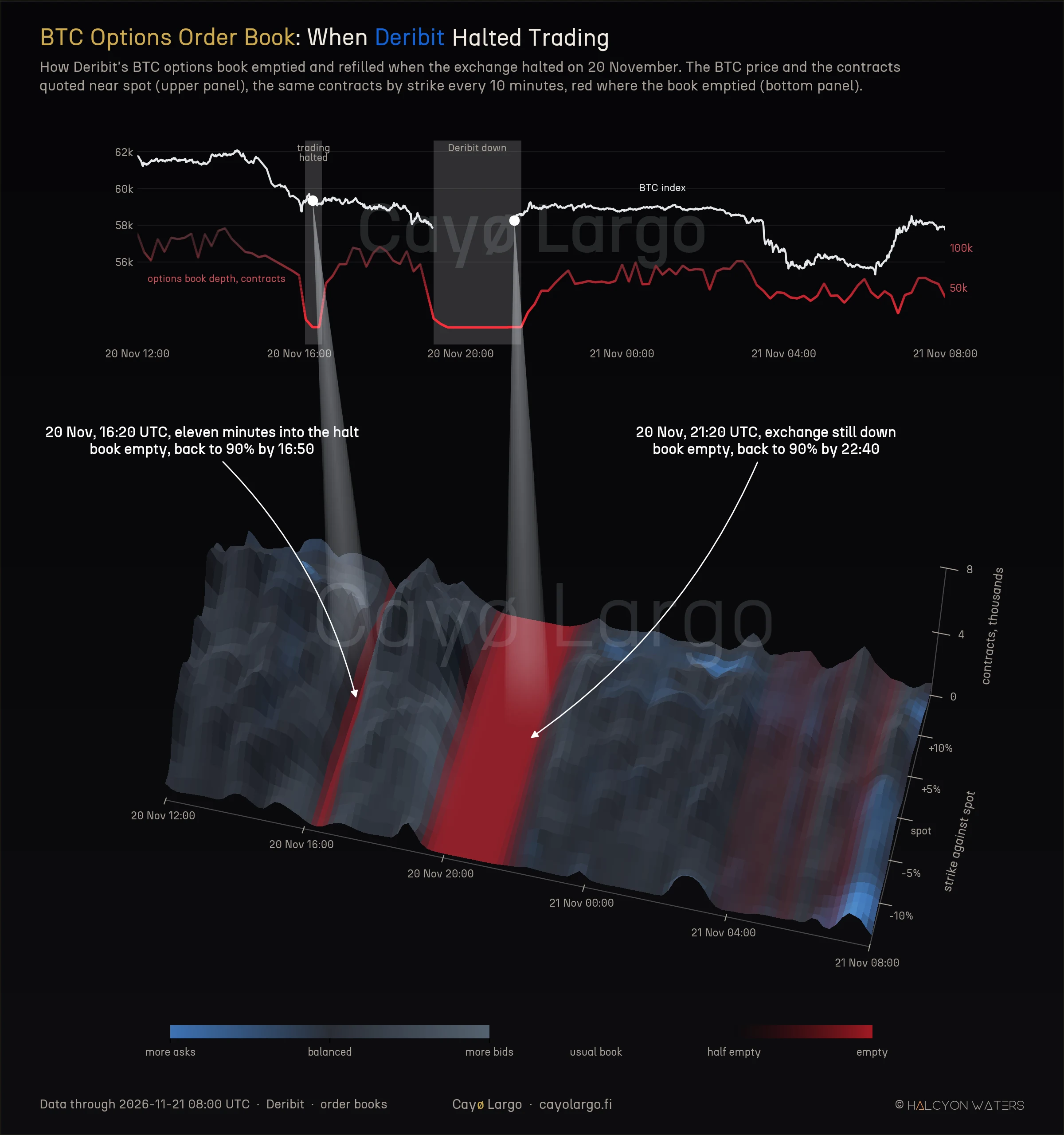
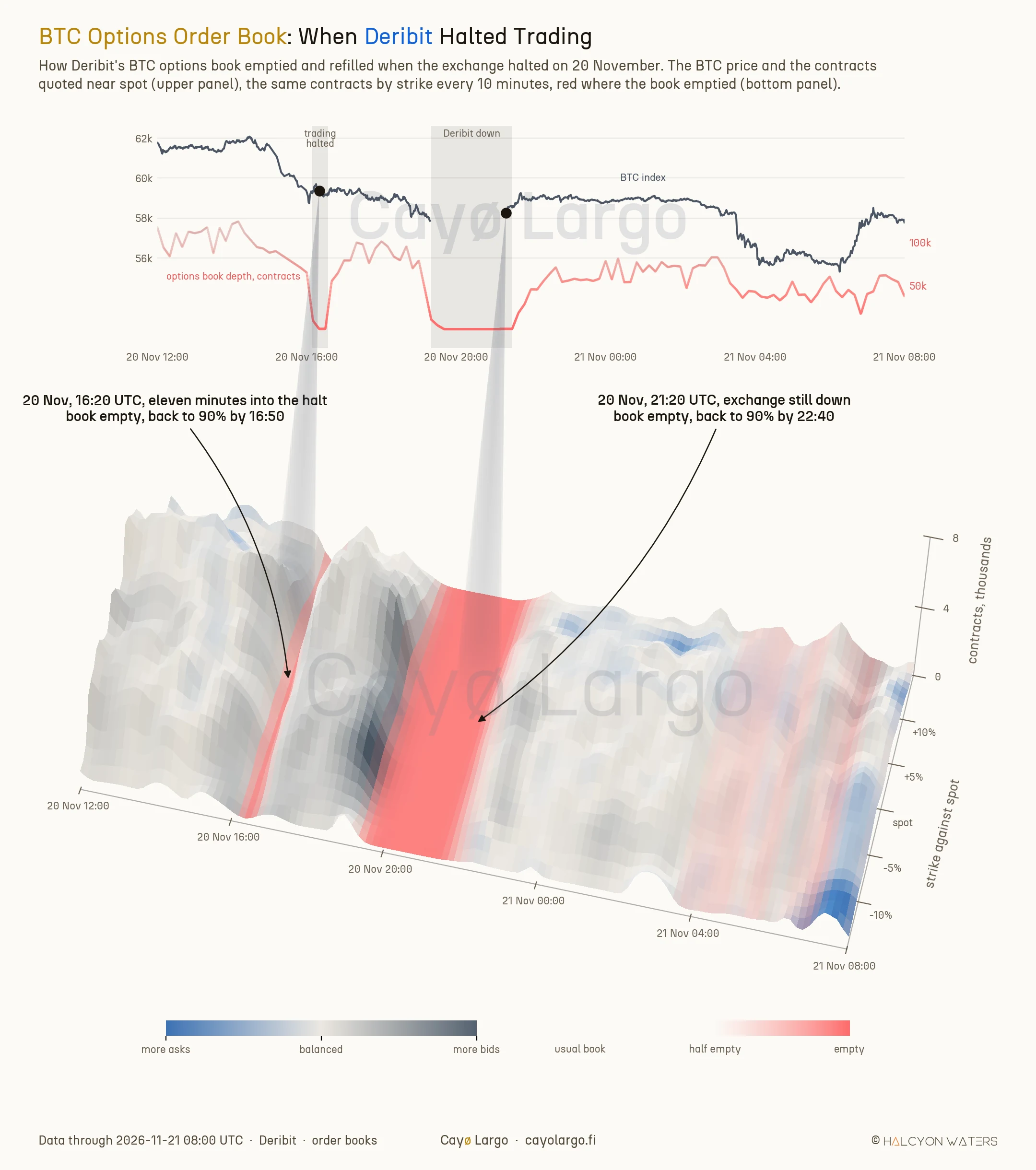
Figure 2: The BTC options book on 20 to 21 November. Upper panel: the BTC index and total book depth, the depth line turning a stronger red as the book empties. Lower panel: the same contracts by strike, blue where asks outweigh bids, slate where bids do, red where the book emptied.
How quickly did the book come back?
We define the refill time, hereafter , as the minutes from the restart to the first reading back at 90% of the book before the stoppage:
where is the minute Deribit resumed trading and is depth at the last complete reading before it stopped. With one reading every ten minutes, is known to within ten minutes. The table gives all three.
| Stoppage | Stopped | First reading | Back to 90% |
|---|---|---|---|
| 5 Nov, trading halt | 13 min | 39% | 41 min |
| 20 Nov, trading halt | 25 min | 85% | 16 min |
| 20 Nov, exchange down | 130 min | 23% | 70 min |
First reading is depth at the first 10-minute reading after trading resumed, as a share of .
The 25-minute halt on 20 November was the easiest to recover from. Six minutes after trading resumed the book held 85% of what it had before. Sixteen minutes after, it was back to 99%. The outage was the hardest. Ten minutes after Deribit came back the book held 23% of its earlier size. It took 70 minutes to reach 90%.
The 5 November halt is the one that does not fit a simple story. It was the shortest of the three, at 13 minutes. Yet the book took 41 minutes to refill. It is also the only one that hit in the middle of a sell-off. Market makers returning to a falling market came back slower than market makers returning to a calm one. One event cannot prove that. It is what a desk would expect, though: a resting quote is a free option handed to whoever trades against it. That option is worth more when the underlying moves 4% an hour.
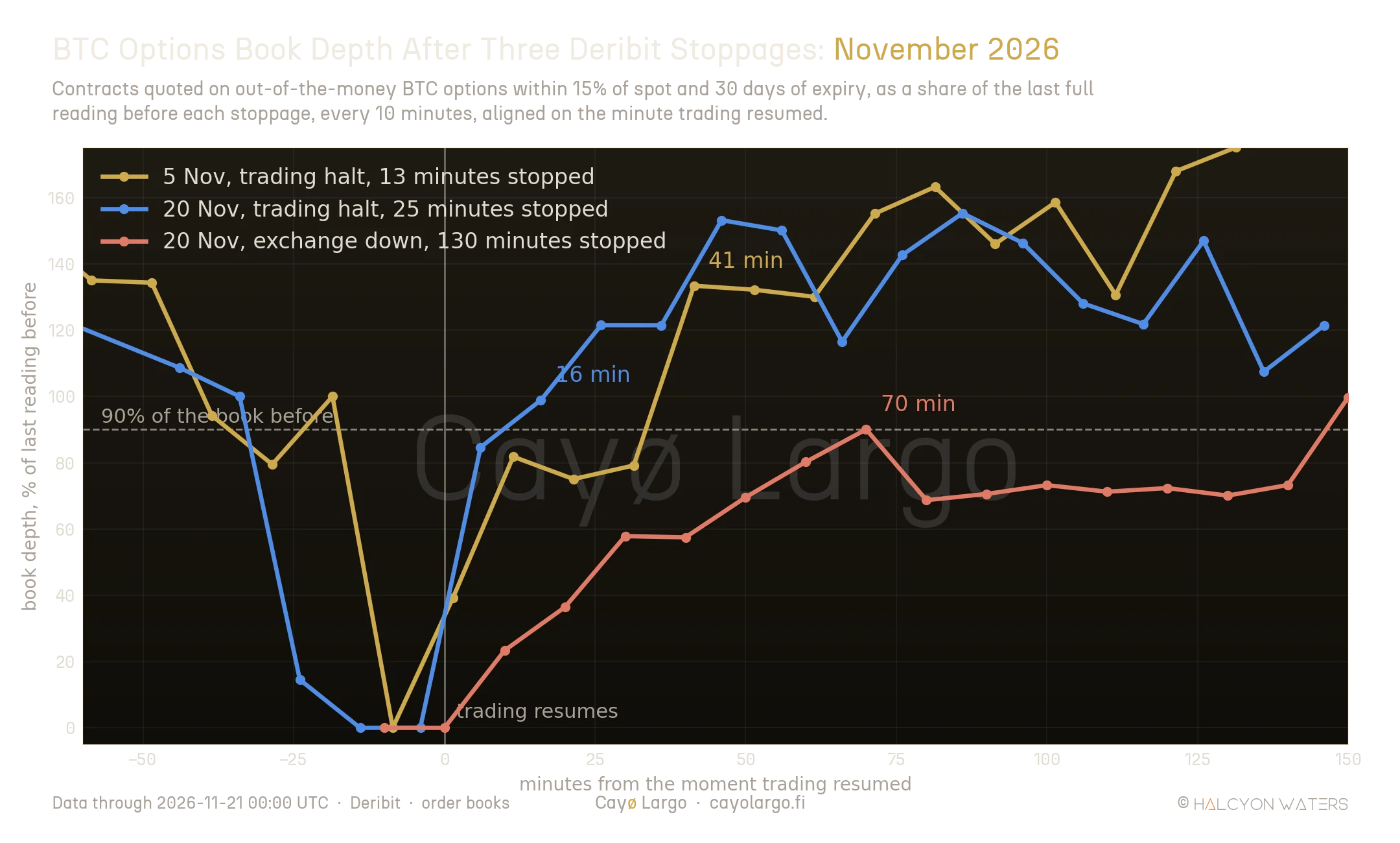
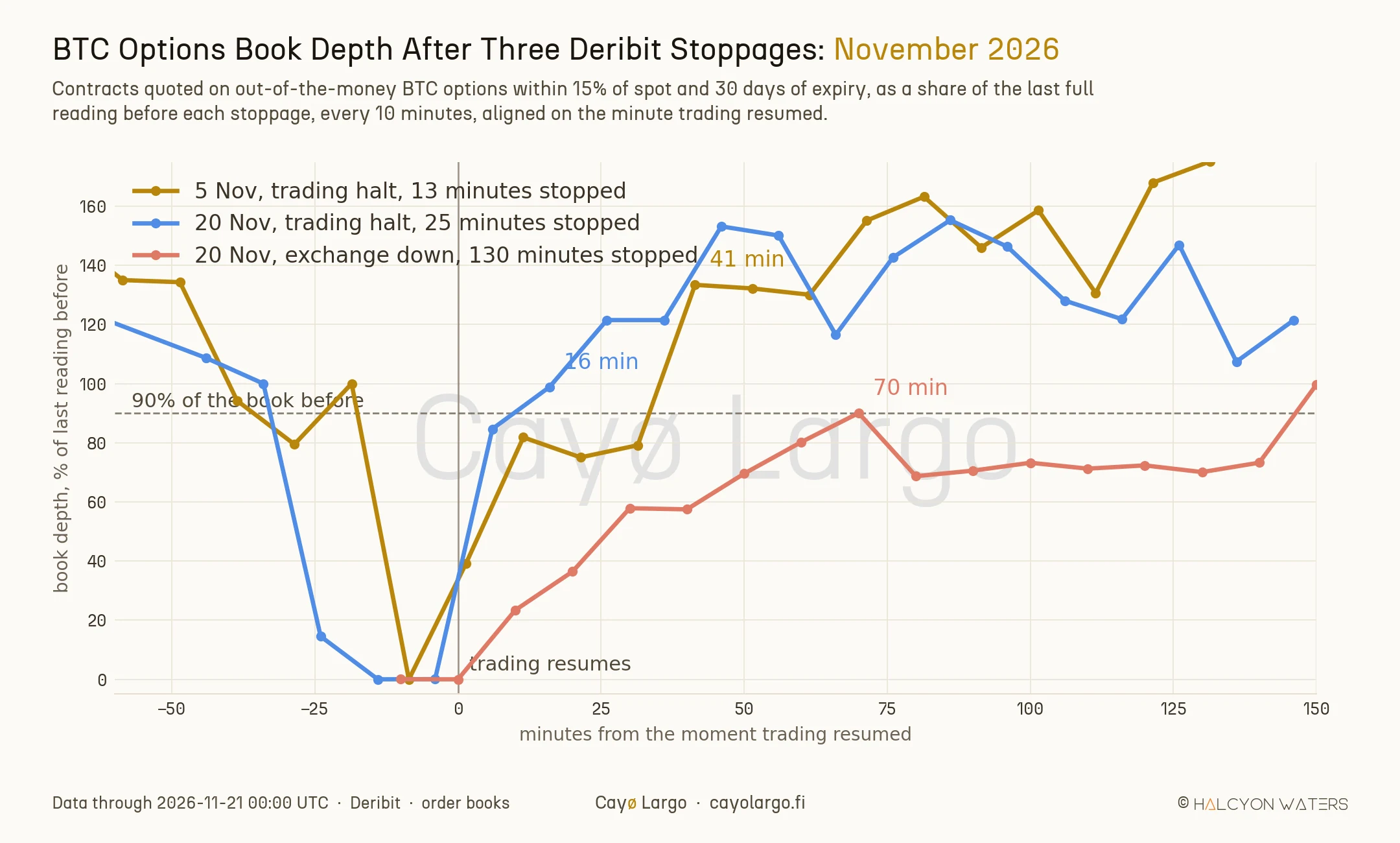
Figure 3: Book depth after each stoppage, as a share of the last full reading before it, aligned on the minute trading resumed. The dashed line is 90%. Labels give each refill time.
The book came back balanced every time. At the first reading after each stoppage the ratio of bid size to ask size was 0.97, 0.98 and 1.00. Market makers did not return to one side first. What differed between the three events was how much size they put back, not which side they favoured.
The same picture from every option on the board.
Our depth measure counts only options with a usable two-sided book. A fair question follows: was the book empty, or had it merely turned one-sided? The market-data layer answers it: the book was empty. That layer stores every BTC option at every reading, whatever its book looks like. The table compares, across all strikes and expiries, the options quoted on both sides and the size at the best bid and offer, before and at the emptiest reading.
| Stoppage | Two-sided books | Size at best quotes |
|---|---|---|
| 5 Nov, trading halt | 96% to 16% | 2.6% |
| 20 Nov, trading halt | 95% to 21% | 3.9% |
| 20 Nov, exchange down | 93% to 18% | 3.4% |
Two-sided books is the share of all BTC options with a bid and an ask, before and at the emptiest reading. Size at best quotes is the total size at the best bid and best ask across all options at that reading, as a share of the reading before.
About four in five options lost one side of their book or both. What survived carried almost no size. The quotes left behind look like the 58,000 put in Figure 1: a tenth of a contract, far from the mark. US regulators described the same thing in their joint report on the equity Flash Crash of 6 May 2010. Market makers widened their quotes, reduced their size or withdrew from the market completely. In their place stood so-called stub quotes, far from the market.
What does a quiet Friday look like?
A falling book is only news against what the book normally does. We checked. We took 344 ordinary readings outside the stoppages, on 30 to 31 October, 5 to 6 November and 20 to 21 November. Depth fell below half of its trailing two-hour median twice and never below 42%. All three stoppages took it to within one contract of zero. The ten-minute swings you see in Figure 3 are therefore the book's normal breathing. The stoppages are a different kind of event.
The outage also left no lasting mark on the evening. Overnight, from 23:00 to 03:00, the book sat at 63% of its Friday midday size. On the previous two Fridays it sat at 59% and 55% at the same hours. What thinned it further was the sell-off early on Saturday. BTC slid to 55,315. The same strikes held just over a third of their midday size.
How we measured it.
Depth comes from the deribit_options_liquidity table behind the liquidity endpoint. It stores the full bid and ask ladder of every BTC option every 10 minutes, provided the book is two-sided with a spread of at most 50% of the mid. We summed contract sizes across every level of every out-of-the-money option within 15% of spot and 30 days of expiry. Five readings on 20 November that hold fewer than 600 BTC options are treated as incomplete snapshots and left out of the reference levels. The cross-check in the second table reads deribit_options_marketdata, which keeps every option whatever its book. Stoppage times come from Deribit's public trade history. Nothing here is modelled. The same book is drawn live, strike by strike, in the Vol Surface Explorer.
What we did not test?
As usual our reading rests on a few choices worth naming. Three stoppages are three observations, not a law. The ordering by refill time could change with the next one. A ten-minute snapshot also cannot see inside the ten minutes. The first quotes after a restart may have arrived in seconds and been pulled again before our next reading.
We measured that the quotes disappeared, not why. Deribit lets a market maker ask for every order to be cancelled when its connection drops. After its 2020 outage the exchange also opened a five-minute order cancellation period before trading resumed. Either would leave the book empty at the restart. The data cannot tell them apart. Nor have we measured what the thin first book cost a trader in spread or in slippage. Our exit slippage note does that for ordinary days.
What to watch at the next restart.
A desk that has to trade the moment Deribit returns is trading into the thinnest book of the day. How thin depends on what the market was doing when it stopped. Calm helps. A practitioner put it plainly this summer: when volatility spikes, quotes widen and size shrinks exactly when hedgers need it most. Deribit built its circuit breaker for a different job. It locks a market for 30 seconds when the index moves more than 2.5% in a second, to let participants catch up. The halts measured here lasted 13 to 130 minutes, long enough for the book to leave and take its time coming back. If you backtest across these windows, the lesson of our note on four traps between a crypto-options backtest and a profit applies in full. A fill the book could not have given is not a fill.
References.
Staffs of the CFTC and SEC, Findings Regarding the Market Events of May 6, 2010, 30 September 2010. The regulators' account of the equity Flash Crash. Its executive summary describes market makers widening quotes, cutting size or withdrawing completely, stub quotes far from the market filling the gap and a five-second pause in the E-mini future after which buying interest returned.
Deribit, Statement of the Outage on August 27, 2020, Deribit Insights, 28 August 2020. The exchange's account of a four-hour outage caused by a hardware failure in its master node, including the five-minute order cancellation period it opened before trading resumed.
Deribit, The (Flash) Crash of May 19, 2021, Deribit Insights, 22 May 2021. Describes the circuit breaker Deribit introduced after March 2020: a 30-second halt of a single market when its index moves more than 2.5% in one second, intended to let participants catch up with the market.
Vitor Gaspar, Options market makers: who is on the other side of your hedge, LinkedIn, 15 August 2026. A practitioner's description of the dealer side of the options market, arguing that market-making capacity runs on capital and risk limits and that executable size collapses in stress while screens still show prices.
Frequently Asked Questions
What happens to the Deribit options order book during a trading halt?
It empties rather than freezes. In the three Deribit stoppages of November 2026, the share of BTC options quoted on both sides fell from about 95% to between 16% and 21%. The size resting at the best bid and offer fell to between 2.6% and 3.9% of its level just before. What remained were small quotes far from the mark price.
How long does the Deribit options book take to refill after a halt?
In November 2026 the near-spot BTC options book was back to 90% of its pre-halt depth 16 minutes after a 25-minute halt on 20 November and 41 minutes after a 13-minute halt on 5 November, which came in the middle of a 4.2% fall in BTC. After a 130-minute outage on 20 November it took 70 minutes.
Does the options book come back one-sided after a Deribit outage?
Not in these three events. At the first full reading after each stoppage, contracts on the bid and on the ask were within 3% of each other: the ratio of bid size to ask size read 0.97, 0.98 and 1.00. Market makers came back to both sides together. What changed was how much size they put back, not which side they favoured.
Related Articles
Deribit Options Execution Slippage: The Exit Costs More
We measured 469,000 Deribit option trades over six months: the buyer fills at mark, the seller gives up 1.4% to 2.9% and the quoted spread predicts neither.
4 Traps Between a Crypto-Options Backtest and a Profit
Four crypto-options signals that shine in backtest and die at real fills. What the spread, the wrong vehicle, overlapping windows and a trending coin cost you.