Why Knowing Your Greeks Won't Save You on Deribit
You learned Delta, Gamma, Theta. You can explain Black-Scholes over coffee. Then you open Deribit's options page and none of it helps. Here's why options theory breaks down on a live screen.
"Because knowing what a Delta is doesn't prepare you for this mess."
Three weeks of reading will get you fluent in the vocabulary. Black-Scholes, the Greeks rattled off like a grocery list, put-call parity as basic arithmetic. Then you open Deribit's options tab for the first time.
What arrives is not the clean, tidy example from the tutorial. It is a wall of numbers, hundreds of them. Here is what a typical session looks like:
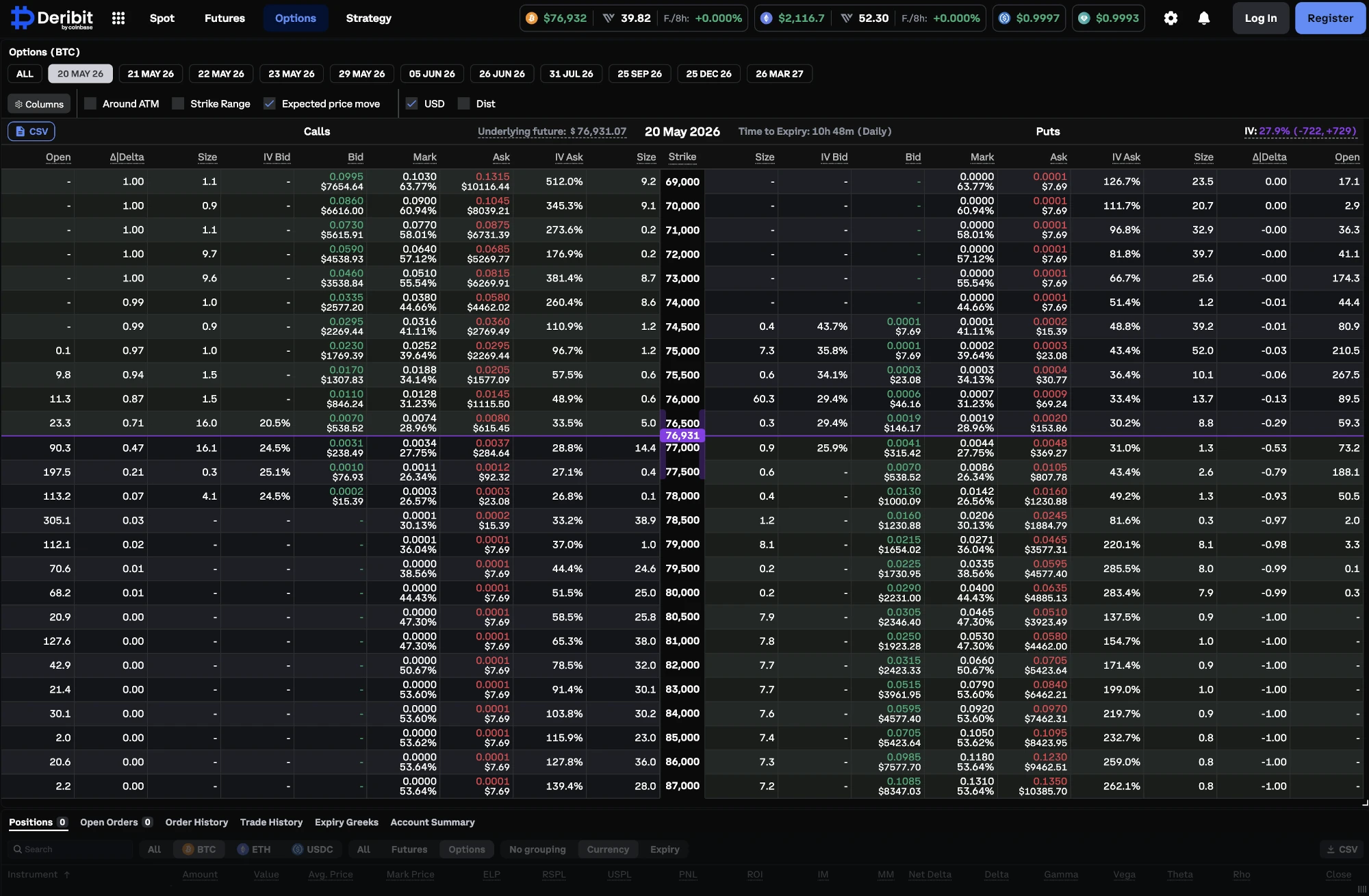
Figure 1: Deribit's Dashboard for Options Trading
The vocabulary survives contact with that screen. The confidence does not.
The Smart Trader's Paradox
Here is the part nobody mentions: the more you know about options, the worse this dashboard hits you. A total beginner picks something and clicks, while you did the homework and now know there is a right answer buried in the mess. You simply cannot find it.
The underlying sits at $76,931 and strike prices run from 69,000 to 87,000, some carrying decent volume and some showing nothing at all. Implied volatility jumps from strike to strike and bid-ask spreads range from tight to laughable. And with expiration hours away, every minute spent thinking is money draining from potential trades.
When Theory Crashes Into Reality
The tutorials make it sound easy. "Think the price goes up? Buy a call. Think volatility is high? Sell premium." Clean and logical.
Real trading is nothing like that. It is learning to drive in a parking lot and then being dropped onto a highway with no lane markings.
Take implied volatility. You learned that high IV means expensive options, which is true and useless on its own, because what counts as "high" in crypto? Traditional stocks hit 30% IV during earnings and people panic, while crypto can sit above 100% on a wild week and drop to 28% when things calm down. That 27.9% IV you see on the screenshot, is that cheap? Is it time to load up on options? Or is the market just dead?
And the Greeks. You memorised that Delta measures price sensitivity and then staring at a 0.47 Delta in a live market feels nothing like reading about it in a textbook. Good number, or bad? Nobody covered the part where abstract Greek letters turn into money you can lose.
The Volume Puzzle That Breaks Brains
Volume in crypto options is its own beast. With traditional stocks like Apple or Tesla, liquidity follows patterns and you can spot where the action is. Crypto offers no such courtesy.
Look at that dashboard, where some strikes have trades and others sit empty. What counts as "liquid" here and is 30 contracts solid or paper-thin? How do you read open interest in a market that barely existed five years ago?
There are no textbook answers because the market is still figuring itself out.
That loop is where most people spend their first weeks. Every strike that looks good on paper has garbage volume and every strike with decent volume has ugly Greeks. It feels rigged against anyone trying to think it through.
The Analysis Paralysis Death Spiral
This is where careful traders get trapped, because you try to be methodical: check implied volatility against historical levels, scan Greeks across strikes, compare volume, run profit scenarios. Two hours later you are still staring at a position that expires in six.
The cruel part is that the market keeps moving while you think. That setup you spotted an hour ago has moved: price shifted, IV changed and your analysis is already old news.
You cannot skip the analysis either, because blind trades in options cost real money and the bid-ask spreads alone will eat an account that picks bad entries.
Why Smart People Feel Stupid
This is not about you being slow, it is a design problem. These dashboards were built to show every available data point and nobody stopped to ask whether a trader could use all of it at once.
Think of it this way. If someone handed you a month of raw weather data (temperature every 5 minutes, humidity, wind speed, barometric pressure) could you say whether it will rain today? Probably not. You'd want a simple forecast: "30% chance of rain this afternoon."
That is what happens on an options dashboard. You drown in raw data when what you need is a forecast, because the exchange shows every number it has and gives you no context for deciding anything.
How We Solve the Dashboard Dilemma
Our starting point is simple: every number on a dashboard should help you make a decision, or it should not be on the screen.
Instead of telling you IV is 27.9%, we show you where that sits historically. Is it the 90th percentile of its own past, or the 20th? That one piece of context turns a number into a reading.
where is today's value, runs over the same coin's observations in the lookback window and returns one when the condition holds. It is the least glamorous formula on this site and it does more work than any other. A bare 27.9% tells you nothing. The same 27.9% ranked against that coin's own history tells you whether the market has ever charged less.
We built scoring systems that flag untradeable strikes automatically, so bad spreads and zero volume are filtered before you waste time on them and good liquidity with tight spreads is marked clearly.
Our systems track how implied volatility shifts across strikes and time frames. When institutional money starts building positions in specific areas, we catch those patterns and bring them to your attention.
The Greeks get the same treatment, so instead of raw Delta and Gamma you see how current levels compare to historical norms and what that implies for different market moves.
Building Confidence Through Clarity
We are not here to trade for you. We give you the context to trade with confidence.
When our analysis highlights a strike, you see not only the opportunity but why it exists and what risk travels with it. The quality metrics keep you out of thin markets that would trap you on entry or exit and the alerts help you act before the paralysis sets in.
Frequently Asked Questions
Why don't options Greeks help on Deribit?
Knowing the textbook definition of Delta or Gamma is different from reading those numbers in a live crypto market. Deribit shows raw Greeks across hundreds of strikes without context on which values are normal, which are extreme, or which strikes are even liquid enough to trade.
What makes crypto options Greeks different from traditional markets?
Crypto implied volatility regularly sits above 100 pct, compared to 20-30 pct for most equities. This makes standard Greeks benchmarks unreliable. Volume is thinner, spreads are wider and there is less historical data to compare against.
How do beginners avoid analysis paralysis on Deribit?
Use tools that add context to raw data: IV percentile rankings, liquidity quality scores and automated filtering of untradeable strikes. Focus on a few clear decision criteria rather than trying to analyze every number on screen.
What should I look for instead of raw Greeks on Deribit?
Look for IV percentile rankings (is current volatility high or low historically), liquidity quality indicators and risk-adjusted comparisons across strikes. Raw Greeks alone tell you the math, not whether the trade makes sense.
Can you trade Deribit options as a beginner?
Yes but the interface is built for data completeness, not decision-making. Beginners benefit from analytics platforms that translate raw Deribit data into context: which strikes are tradeable, which are overpriced and which carry hidden risks in thin liquidity.
Related Articles
4 Traps Between a Crypto-Options Backtest and a Profit
Four crypto-options signals that shine in backtest and die at real fills. What the spread, the wrong vehicle, overlapping windows and a trending coin cost you.
Why Deep-OTM IV Momentum Is Noise, Not Signal
A stable IV smile but wild IV momentum at deep-OTM strikes. Why thin-strike microstructure is noise, not repricing, shown live on Deribit multi-coin data.
Why Crypto IV Spikes Before Expiry: The Bow Shock
Why does crypto implied volatility spike before expiry? An IV Footprint heatmap shows a bow-shaped front flaring at the wings before each Deribit settlement.
Dealer Greek Exposure: GEX, Charm and Vanna, With the Maths
How dealer gamma exposure (GEX), charm and vanna are actually built, formula by formula and how the order-flow sign is set. Computed on live Deribit options data.
Crypto Variance Risk Premium: Live IV vs RV on Six Coins
How to read IV vs RV charts and the variance risk premium to figure out whether crypto options are overpriced, underpriced, or fairly valued. Live AVAX example from Deribit.
How to Read Gamma Exposure: Bitcoin GEX Live Case Study
BTC trades at $77,140 with $51 million in put open interest stacked at $76,000 and the gamma regime deep in negative territory. Expiry is 16 hours away. Here's how to read every chart on the GEX Landscape page and what each one tells you about what happens next.
Gammega at +3.5σ: When Spot and IV Pull Apart
BTC Gammega hit +3.5σ over 30 hours as spot rallied and IV fell. Fourth-order stress invisible to standard dashboards. Gamma exploded 30 hours later.
The 37-Greek Compression: Options Surface in Three Lines
37 Greeks compressed into three lines. White shows non-linearity. Gold flags pre-event tension. Red fires during structural stress. The ratios, the maths behind them and how to read the surface off a single panel.